
TL;DR
To elevate a “boring” maximalist wall, create contrast (add warm, high-saturation accents), anchor the gallery with 1–2 large pieces, lower the layout to eye level, upgrade lighting, and consider crown or picture-frame moulding. Test colorways, frame sizes, and art placement in minutes by uploading a photo to ReimagineHome.ai. For anyone searching “how to fix a gallery wall” or “AI to visualize furniture layout,” this approach reduces risk, works in rentals, and curbs decision fatigue.
Why This Wall Feels ‘Off’ (and Why You’re Not Imagining It)

Anchor gallery walls with large pieces, warm accents, and layered lighting to make art pop.
Most gallery walls fall flat because there’s not enough contrast and no focal point. Anchor the composition with a larger piece, lower the overall layout to eye level, then weave in high-warmth accents and layered lighting so your art pops against the blue.
- Contrast first: add warm accents (mustard, coral, brass, antique gold) to cut through the all-blue scheme.
- Anchor the gallery: one large piece centered over the sofa organizes the smaller ones.
- Lower and tighten spacing: bring art down to eye level with 2–3 inches between frames.
- Light the wall: picture lights, sconces, and a tall floor lamp add depth and sparkle.
- Add architecture: crown moulding or picture-frame moulding gives order to maximalist chaos.
- Mix flat + 3D: shelves, sculptural pieces, or plants create relief and dimension.
- Pet-friendly texture: swap dried florals for pressed flowers in frames or faux stems.
Before you move a single sofa or pick up a paint roller, upload a photo to ReimagineHome.ai and test a few ideas safely.
If you want a deeper primer on visualizing options with AI, skim this breakdown of AI interior design tools. For color planning, see our guide to building a room color palette, and if you’re mapping out compositions, browse gallery wall layout ideas.
Why Interior Design Dilemmas Are Usually About Layout, Scale, and One Wrong Piece
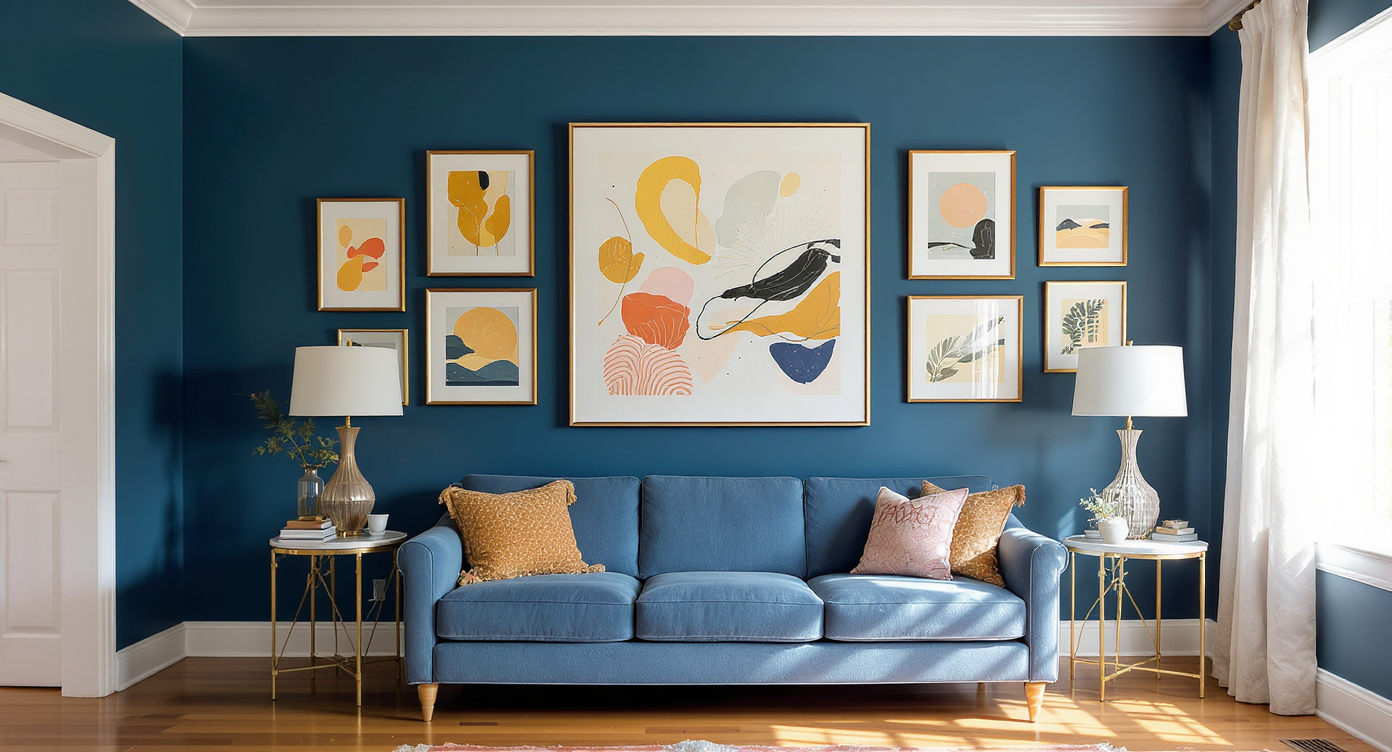
Proper artwork scale and layout are key to solving gallery wall dilemmas and creating harmony.
Most designers recommend hanging artwork so its center sits about 57–60 inches from the floor; above a sofa, keep the bottom of the artwork roughly 6–10 inches above the back cushion. When everything skews too high or too small, a wall reads chaotic instead of collected.
What’s really going on in rooms like this? Scale, circulation, light—and often one mismatched element—do the heavy lifting. In an all-blue scheme (wall + sofa), the eye loses edges. The sofa falls into the wall, so even great art can’t stand out. Add a too-high, scattered gallery and your focal point disappears entirely.
The fix isn’t “more stuff.” It’s organization and contrast. One large anchor—roughly two-thirds the width of the sofa—gives the eye a home base. Lowering the entire collage creates a cohesive band of interest. Then a few high-chroma accents (mustard, burnt orange, coral, chartreuse), brass frames, and warm lighting reintroduce depth. If your ceiling is already a statement, crown moulding or picture-frame moulding can give all that ornament somewhere formal to sit.
Working with a corner? Pull weight toward the center: avoid parking the largest piece in the tightest edge. Mirrors inches from the ceiling compress the room—bring them down so they reflect faces and lamps, not only cornices.
For layout sketches and planning in tight spaces, you can also reference a detailed guide to small living room layouts—the same scale logic applies to gallery walls over sofas.
Anecdote
That corner where the mirror grazes the ceiling? Bring it down, center a bolder piece over the sofa, and suddenly the whole wall looks curated—not crowded.
Furniture & Art Rules That Quietly Solve Most Gallery-Wall Problems
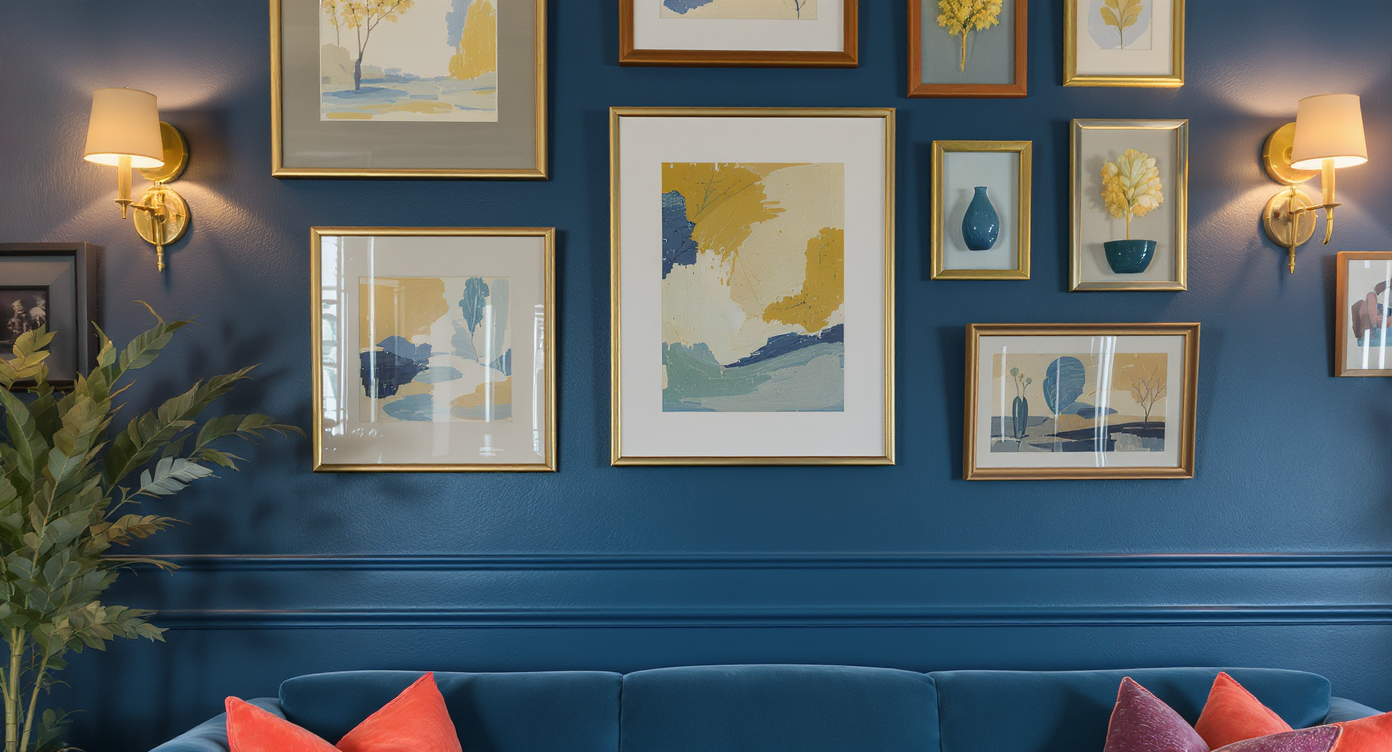
Consistent spacing and mixing art with 3D elements quietly solves gallery wall design challenges.
Keep 2–3 inches between frames in a gallery wall; consistency reads as intentional even when the collection is eclectic.
- Anchor size: aim for an artwork or framed textile that’s about 2/3 the width of the sofa. If the sofa is 84 inches, target a 54–60 inch-wide anchor piece or a tight diptych/triptych.
- Height alignment: center most pieces at 57–60 inches; groupings can span higher/lower but keep the visual weight low and centered above the sofa.
- Frame weight: mix thicker, ornate frames among slim ones so the wall has “bass notes.” Consider vintage-gold or ebonized wood for contrast on blue.
- Color rhythm: repeat your accent color at least three times (e.g., two pillows + one frame mat) to feel deliberate.
- Pillows with presence: 22–24 inch pillows in patterned velvet, tapestry, or fringe read maximalist; two to four beats in mustard/coral will wake the sofa.
- Lighting placement: sconces typically sit with bulb centers around 60–66 inches from the floor; picture lights should be about one-third to one-half the width of the artwork they illuminate.
- Crown moulding: for 8-foot ceilings, 3–5 inch crown looks balanced; for 9–10 feet, 5–7 inch. Paint crown to match the wall or highlight details with brushed gold to echo frames.
Want to see these rules in your exact room? Generate options in ReimagineHome.ai, then compare side by side before you drill a single hole.
How ReimagineHome.ai Helps You Test Layouts, Styles, and DIY Ideas

Test gallery wall layouts and styles easily before committing with ReimagineHome.ai’s tools.
AI tools can show multiple layout, color, and trim variations in minutes, reducing returns and patchwork holes. With ReimagineHome.ai, you can redesign from one photo—no measurements required—to preview bold choices fearlessly.
- AI interior design from photo: upload the wall, then try a large anchor artwork vs. a tight salon arrangement. Swap in ornate gold frames or thick ebonized profiles.
- Room layout AI for small spaces: center the composition over the sofa, drop it to eye level, and tighten spacing to 2–3 inches—then export versions to compare.
- Paint and finish testing: audition complementary palettes (navy + mustard, teal + coral, plum + chartreuse). Try color-drenching trim or adding crown with subtle gold highlights.
- Lighting and 3D layers: add battery sconces, picture lights, and a tall arc or pharmacy lamp. Test a sculptural shelf, pedestals, or a plant to break up the “flatness.”
- Style swaps: explore Scandi-meets-Deco, Dark Academia, or Boho-maximalist journeys in seconds. If you’re choosing tools, skim this deep-dive on AI room makeovers and planners.
Because it’s a virtual room design workflow, you can iterate fast—like an AI room planner and mood board in one—then act with confidence.
Step-by-Step: Elevate This Maximalist Wall with AI and Simple DIY
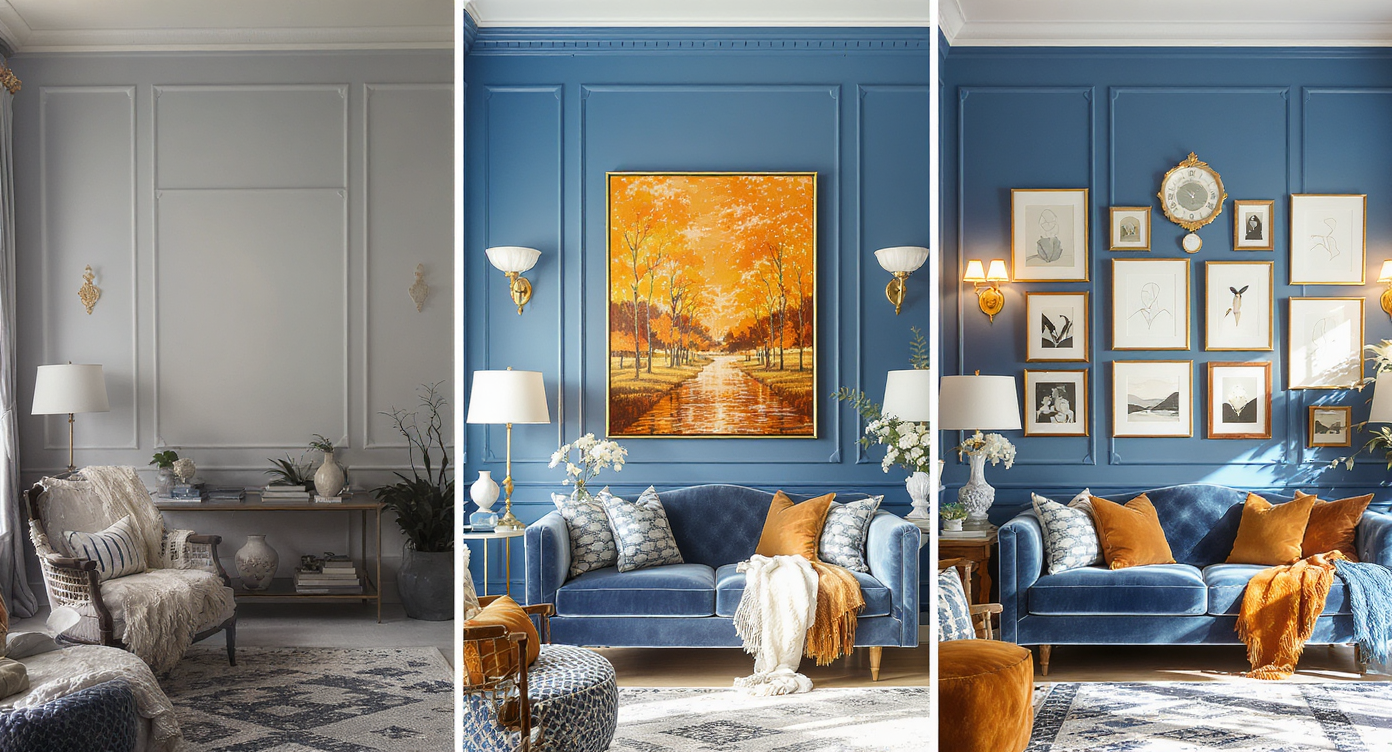
Elevate your gallery wall with crown moulding, lighting, and strategic art placement step-by-step.
Most rooms feel better when you create 30–36 inches of clear walkway in front of the sofa; if space is tight, prioritize slimmer side tables and wall-mounted lighting.
- Photograph the wall straight on. Upload to ReimagineHome.ai and generate two tracks: (A) one large anchor centered over the sofa; (B) a structured salon with consistent 2–3 inch spacing.
- Dial in contrast. Test warm-accent palettes (mustard, coral, terracotta, chartreuse). Save three versions and compare like a room makeover AI storyboard.
- Try moulding. Add crown (3–5 inches for 8-foot ceilings) or picture-frame moulding. Visualize blue-on-blue with brushed-gold highlights versus crisp off-white trim.
- Light it. Place a floor lamp just taller than the sofa back; add two picture lights or battery sconces at 60–66 inches. Render to confirm glare and reflections.
- Add 3D relief. Mock up a slim shelf, small pedestal table, or plant to break the plane. If cats snack on botanicals, try pressed flowers framed under glass.
- Commit physically. Lower art to 57–60 inches center. Center the anchor at two-thirds sofa width; keep a 6–10 inch gap above the sofa back. Use a paper template to premark holes.
- Layer textiles. Add 22–24 inch patterned pillows (two warm, one cool neutral) and a high-contrast throw draped along the back to separate sofa from wall color.
- Final polish. Swap a few thin frames for chunkier vintage-gold ones; consider matting in black or warm cream to intensify contrast.
For color sequencing and accent placement, refer to our color palette guide.
Visualization Scenario
Upload your wall to ReimagineHome.ai, generate a version with a mustard-and-brass palette, thick vintage frames, and 5-inch crown with gold highlights, then compare it to a coral-and-ebonized frame scheme with picture lights—choose what sings before you drill.
FAQ
How do I fix an awkward gallery wall without buying all new art?
Lower the entire arrangement to eye level, add one larger anchor (about 2/3 the sofa width), and keep 2–3 inches between frames. Use a few thicker, contrasting frames to add weight.
Which AI interior design tool is best for testing gallery wall layouts?
ReimagineHome.ai lets you redesign a room from one photo, so you can try anchors, spacing, trim, and lighting in minutes—ideal for small apartments and rentals.
How can I see if a new color or crown moulding will work before I paint?
Upload a photo, then swap paint colors and add trim virtually to compare versions side by side. This virtual room design workflow cuts paint sampling and patching.
Can I use AI tools to plan DIY picture lights or sconces?
Yes—mock up battery sconces and picture lights at 60–66 inches high and confirm scale and glare. For tool options, skim this tool comparison.
What’s the easiest way to add contrast to a monochrome sofa + wall?
Introduce warm, saturated pillows (22–24 inches), a high-contrast throw, brass or warm-wood frames, and targeted lighting. Repeat accent colors at least three times for cohesion.
Visualize Your Room’s Next Chapter
A maximalist wall thrives on intention: a strong center, consistent spacing, and enough contrast to let treasures sing. When you can preview bold moves—moulding, lighting, big art—on your exact wall, it stops feeling risky and starts feeling fun. Visualize it, then enjoy the drama.
When you can see the possibilities, it’s easier to move with confidence. Start by uploading one honest photo to ReimagineHome.ai and let your next version of the room come into focus.