
TL;DR
Photographers are rethinking real estate photography pricing to avoid a race to the bottom. Nationally, a $150–$300 base with add-ons that lift average orders to $300–$600 is common, while top metros skew higher. The agents who hire again and again reward consistency, fast turnarounds, and clear packages over bargain-bin promises.
Real estate photography pricing that actually works now
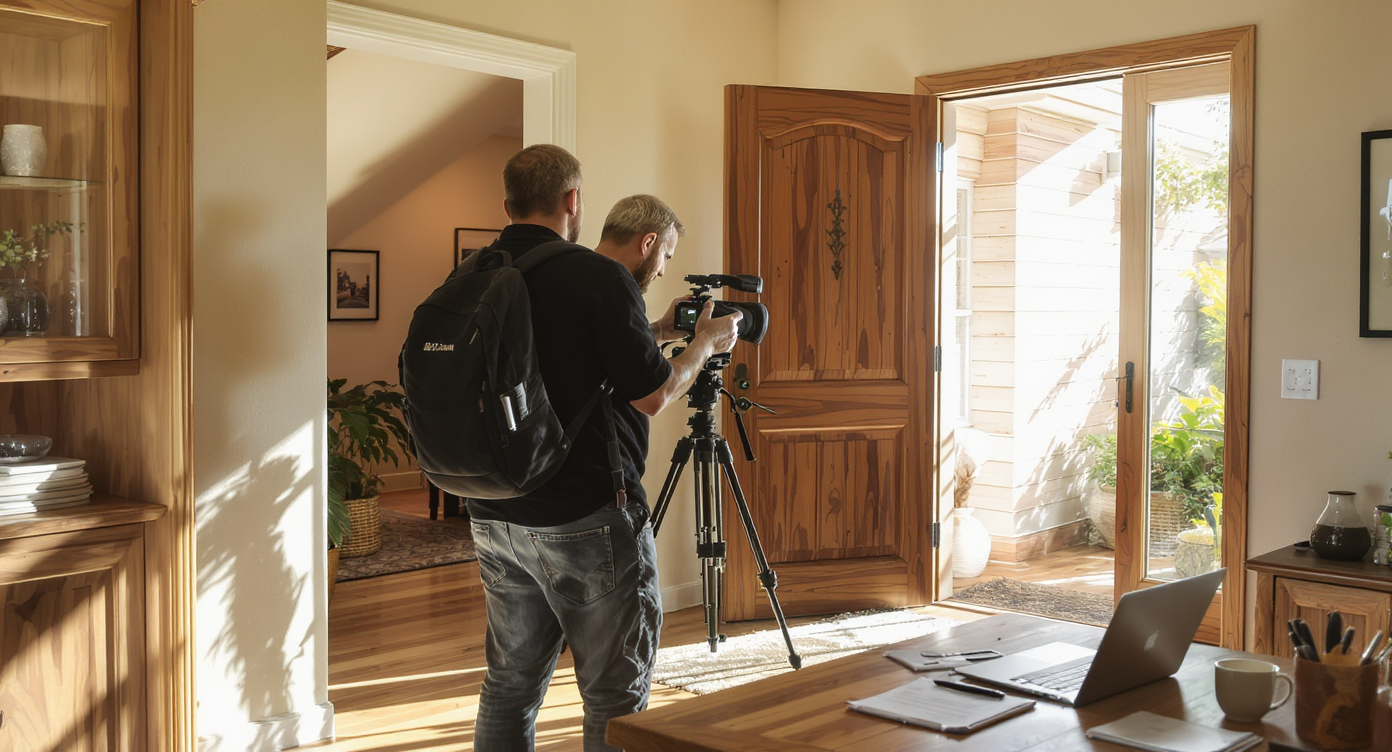
Professional photographers balancing quality and cost help agents overcome pricing anxiety.
Pricing anxiety is real in real estate marketing. Professional property photos consistently pull more attention online — marketers often cite 40–60% higher listing engagement when visuals are sharp, well lit, and consistent — yet photographers still feel pressure to undercut. Here’s the thing: agents usually don’t hire the cheapest shooter twice. They hire the one who shows up, turns work around in 24 hours, and makes the listing look like a sure thing for buyers. Alt text suggestion: “Bright, balanced wide shot of a staged living room highlighting natural light and clean lines.”
National benchmarks: what agents expect and what pros charge
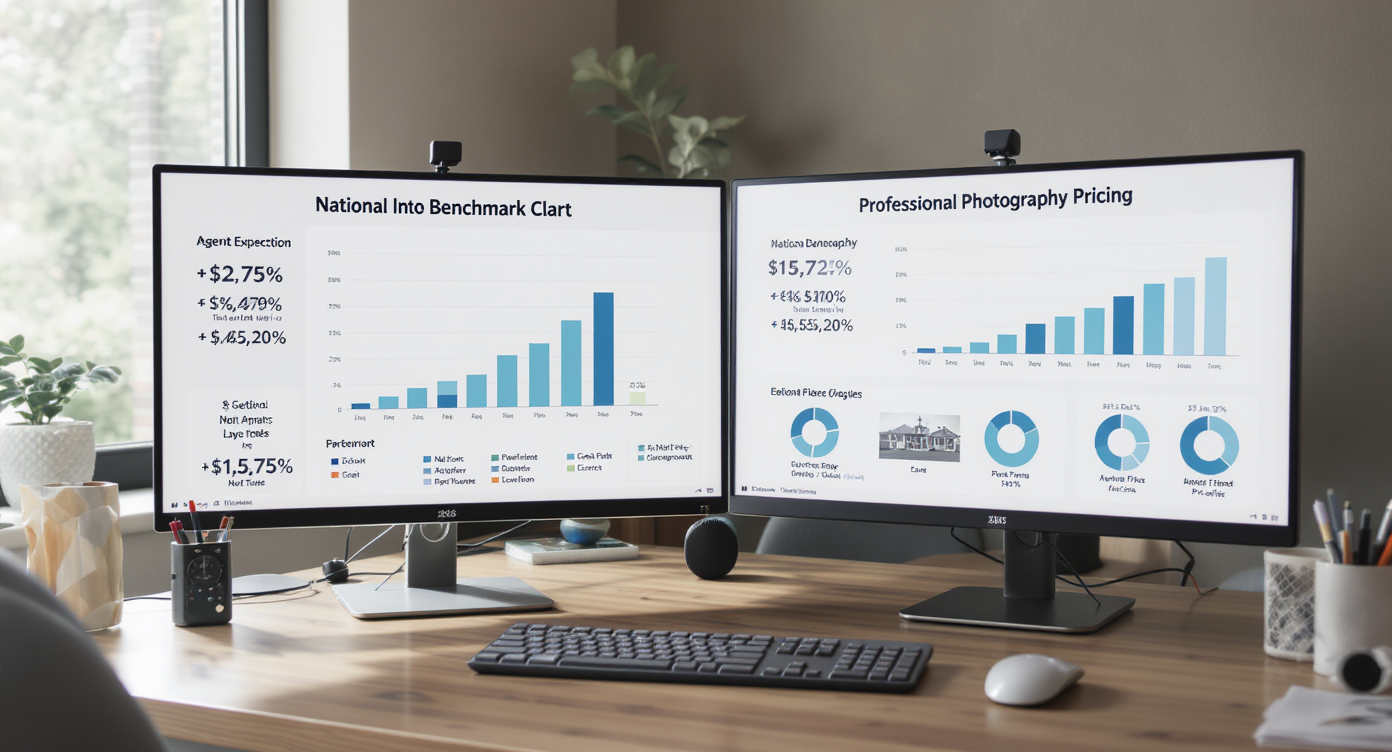
National benchmarks detail agent expectations versus professional photography charges.
Homes with professional real estate photography get more clicks and better time-on-page, agents say — but the business only works if the numbers do. Across the U.S., a common baseline for standard property photos is $150–$300 for an average home and 20–30 images, with add-ons typically pushing the average order to $300–$600. In high-demand metros, many photographers report a $300–$500 base. In lower-cost or volume-heavy markets, entry packages still start under $200, but repeat clients often add services. Market analysts suggest most agents expect 24-hour delivery, MLS-safe editing, and enough coverage to tell the story of the home. That means you’re pricing for the entire workflow — emails, drive time, shooting, culling, editing, upload, and revision buffer — not just time on-site. Many pros who track it estimate that a $300 job nets closer to $60–$80 per actual hour worked after overhead, gear depreciation, software, insurance, and taxes. A popular formula some studios use: a minimum base under a size cap, then a small per-square-foot increment above it. Example: $200 up to 2,000 square feet, then about $0.10 per additional square foot. Others price by image count or rooms because square footage doesn’t always reflect complexity. Data visualization note: Plot base price against “add-on share of revenue,” and you’ll often see 40–60% of monthly revenue coming from extras. Visual caption: “Why your base is not your business.” Alt text suggestion: “Spreadsheet-style chart showing base price vs add-on revenue share for a real estate media studio.”
Anecdote
A team lead in a high-priced coastal market balked at a bargain aggregator’s quote request. Instead of matching, the photographer showed side-by-side visuals, outlined a 24-hour delivery guarantee, and kept a firm $600+ rate with optional aerials. The agent booked the shoot for a $4 million listing, then sent two more that month because the process felt easier and the images were consistent. On the other end of the spectrum, a rural shooter launched with a $150 entry package, added $100 floor plans and a $250 walkthrough, and reached roughly $8,000 in monthly gross within a few months — proof that different lanes can work when the menu is clear.
Regional reality check: LA and NYC aren’t the Midwest
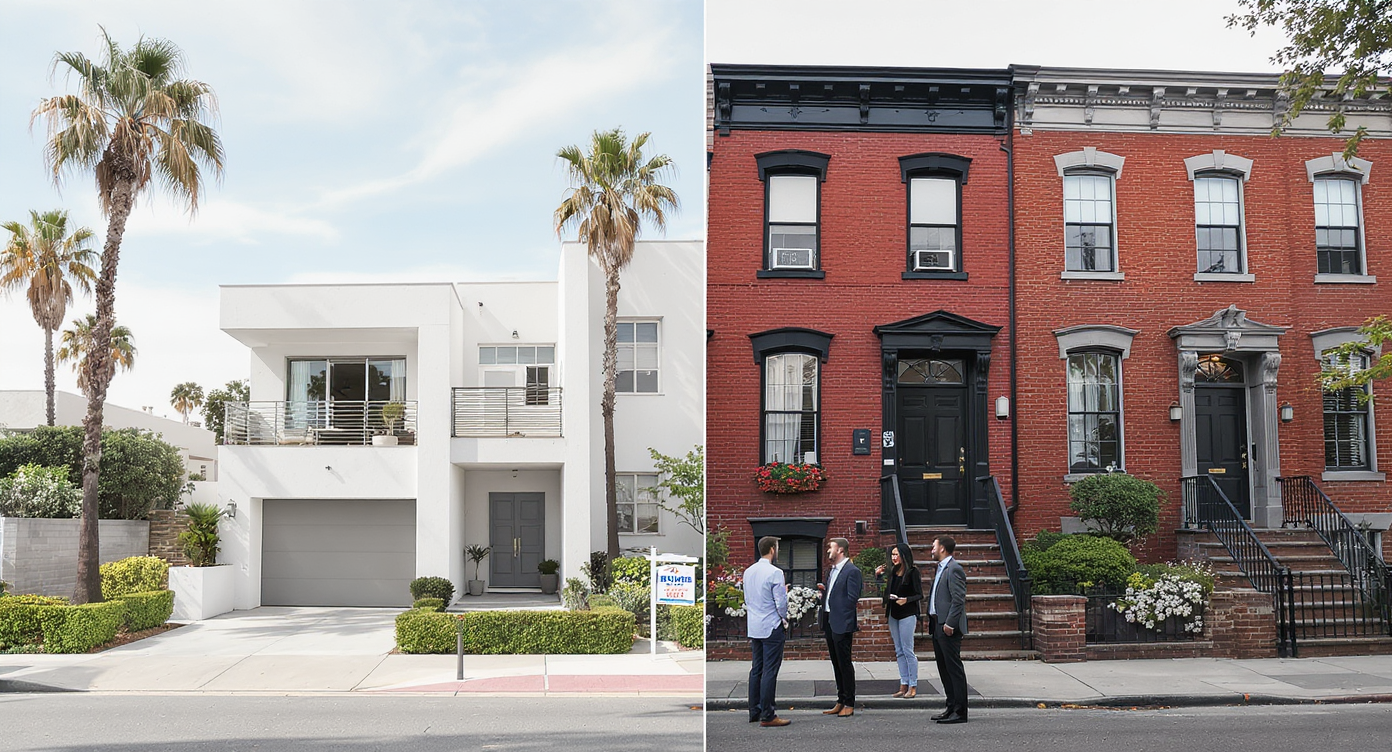
Pricing varies widely: Los Angeles and New York differ greatly from Midwest markets.
Real estate photography pricing is hyperlocal. Photographers in Los Angeles or New York often laugh at a $200 ceiling when the median home price tops $1 million and traffic eats a morning. In those metros, $300–$500 for standard photos is common, with luxury packages spanning much higher. In price-sensitive metros — think parts of Texas and Florida — photo mills advertise $90–$150 basic shoots and stay profitable through volume, tight routing, and minimal post. Across the Atlantic, entry packages in parts of the UK regularly land around £80–£120 for photos alone, while Swiss studios will quote the equivalent of $400–$600 for a typical listing because that’s the local “average” agents expect. Rural U.S. markets can be barbell-shaped: one photographer builds a tidy business with a $150 entry package and heavy add-ons, while another stakes out a premium lane and wins fewer but larger orders. Florida leads on volume-first models, where teams can cover 6–8 homes a day and still hit strong daily gross. Coastal luxury markets, by contrast, pay for time — editorial angles, twilight exteriors, and meticulous styling often justify higher rates. Alt text suggestion: “Map with metro-level callouts: higher base prices on coasts, lower in volume markets.”
What really drives bookings: speed, trust, and a clean menu
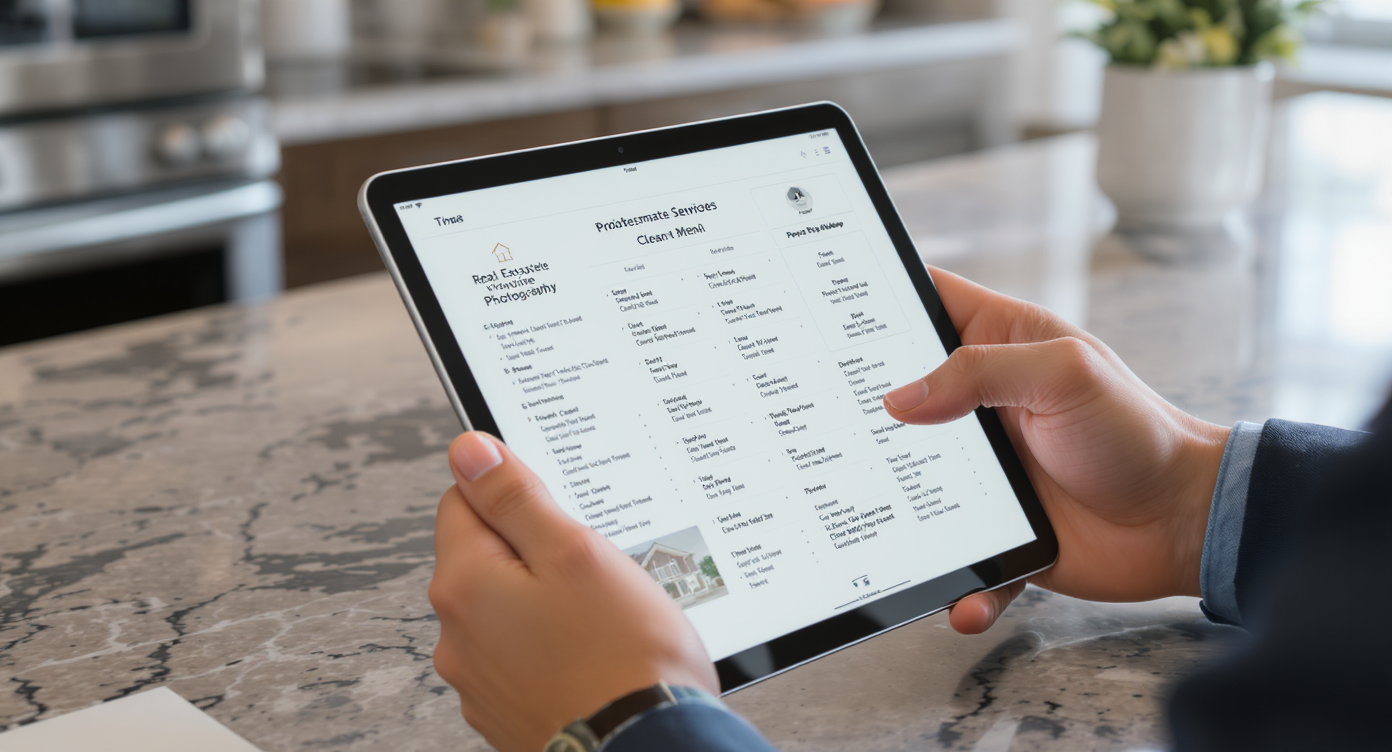
Speed, trust, and simplicity drive repeat real estate photography bookings.
The biggest driver of repeat bookings isn’t the lowest price — it’s reliability. Agents often say they’ll trade perfection for punctuality: on-time arrivals, quick file delivery, filenames that line up with MLS needs, and simple licensing. That’s why free weather re-shoots or promising to return at the exact ‘perfect light’ can quietly wreck a schedule. Scalable policies matter: sky replacements and a clear rainy-day plan keep calendars intact. “I want a photographer who solves problems without creating new ones,” a broker told me recently. That means pick a clean menu, publish turnaround times, and set boundaries on revisions. Buyers don’t zoom in to judge micro color shifts; they scroll to see space, light, and flow. Practical takeaways for photographers:
- Set a sustainable base price. Many pros aim for at least $150–$300 for standard photos to cover true costs and keep margins.
- Define a weather policy. Offer reschedules for true downpours; use sky swaps and consistent editing on overcast days.
- Choose a pricing model you can explain in one sentence: by square foot, by image count, or tiered packages with clear inclusions.
- Track average order value (AOV). If add-ons are under 30% of revenue, your menu may be leaving money on the table.
- Guard your time: batch culling, presets, and outsourcing can buy back hours and protect profit per job.
- Book for consistency, not the cheapest rate. Listings hit the market faster with vendors who deliver in 24 hours.
- Bundle strategically. Floor plans, aerials, and a short video walkthrough can upgrade a listing for a modest incremental spend.
- Ask for usage clarity. MLS-safe edits and brokerage-friendly licensing avoid headaches later.
The add-on economy: floor plans, aerials, 3D — and the outliers

Add-ons like floor plans and aerials boost photographer margins and marketing value.
Add-ons are where many studios make their margin. Floor plans have surged because buyers skim layout first; with phone-based scanning apps, pros can capture plans in minutes and deliver within 12–24 hours. Typical pricing ranges from $50 to $150 for a standard plan, more for detailed measurements. Aerials commonly add $100–$200 for stills; property-line overlays or community amenities can raise perceived value. Short video walkthroughs tend to run $200–$500, while 3D tours often sit in the $150–$300 range per average home. Homes with virtual tours, according to agents who track their analytics, keep buyers on the page longer and can lift showing requests within the first 72 hours. The secret is practicality: a 45–60 second vertical walkthrough can be repurposed across Instagram, TikTok, and listing pages. Counterpoints and outliers matter. Architectural photographers might charge $350 just to scout and quote, then bill day rates 10–20 times higher than basic real estate photography — different market, different deliverables. At the other extreme, large photo mills profit with $90–$150 packages by maximizing routing efficiency, limiting edits, and shooting 6–8 homes a day. Both models work if the math works. One composite example: a rural photographer anchored a $150 entry package, then built average orders around $400 by bundling floor plans and a quick video; within a quarter, monthly gross hovered near $8,000. Another: in a coastal luxury market, a photographer who declined to match a bargain aggregator’s quote still won a $4 million listing by demonstrating superior visuals and a steadier process. A word on “standard pricing.” It’s tempting to wish for one, but antitrust guidance warns against competitors coordinating rates. The safer route: set your own price based on costs, demand, and value — then compete on quality and service. Alt text suggestion: “Split graphic caption: ‘Where profit lives’ highlighting floor plans, aerials, and video as margin drivers.”
Visualization Scenario
Imagine a two-panel chart. Panel A: a bar chart of base price tiers ($150, $200, $300, $400) vs average order value, showing a steady climb as add-ons attach. Panel B: a stacked bar of revenue sources where 40–60% comes from floor plans, aerials, video, and 3D tours. Caption: “Your base keeps the lights on; add-ons grow the business.”
FAQ
How should I price real estate photography for a typical listing?
For real estate photography, many pros start at $150–$300 for standard photos, then use a simple add-on menu. If you need a long-tail plan, adopt a tier or per-image model so clients can scale spend based on the property.
What’s better — pricing real estate photos by square foot or per image?
Both work. Pricing by square foot is predictable for agents, while per-image or room-based pricing better reflects complexity for odd layouts; test each model to see which maximizes your real estate marketing margin.
Which add-ons boost average order value in real estate photography?
Floor plans, aerial photos, 3D tours, and short video walkthroughs are top add-ons in real estate marketing. They typically add $50–$500 and can increase engagement on listing pages.
Are free weather re-shoots a good idea for real estate listings?
Offer re-shoots only for severe weather. Most real estate photography workflows use sky replacements and clear policies to keep schedules on track without eroding profit.
How can agents compare real estate photography packages online?
Look for clear inclusions, 24-hour delivery, licensing terms, and transparent add-on pricing. The best real estate photography packages make it easy to bundle floor plans, aerials, and video when needed.
Where pricing goes from here
Pricing won’t fix a wobbly process, and perfection won’t save an unsustainable price. What wins in real estate marketing is a believable promise: I’ll show the space clearly, deliver fast, and be easy to work with. The base price respects your time; the add-ons tell the full story of the property. Deals don’t die from ordinary skies — they die from missed deadlines and unclear expectations. The outlook: expect more bundling, more demand for floor plans and short-form video, and a steady divide between boutique and volume shops. Pick your lane, publish your rules, and make every listing look move-in ready online. Tools like ReimagineHome help agents and homeowners visualize updates, test staging directions, and preempt buyer hesitation with design clarity before the first photo is taken.