
TL;DR
Finish a blank dining room wall with one strong anchor—either a large artwork (⅔ the table’s width) or a slim console with a mirror and lamp. Maintain a 36-inch walkway, hang the chandelier 30–36 inches above the table, and choose a rug that extends 24 inches past the chairs. Instantly preview these layouts on ReimagineHome.ai .
How to Style a Blank Dining Room Wall: Art, Console, and Lighting Tips
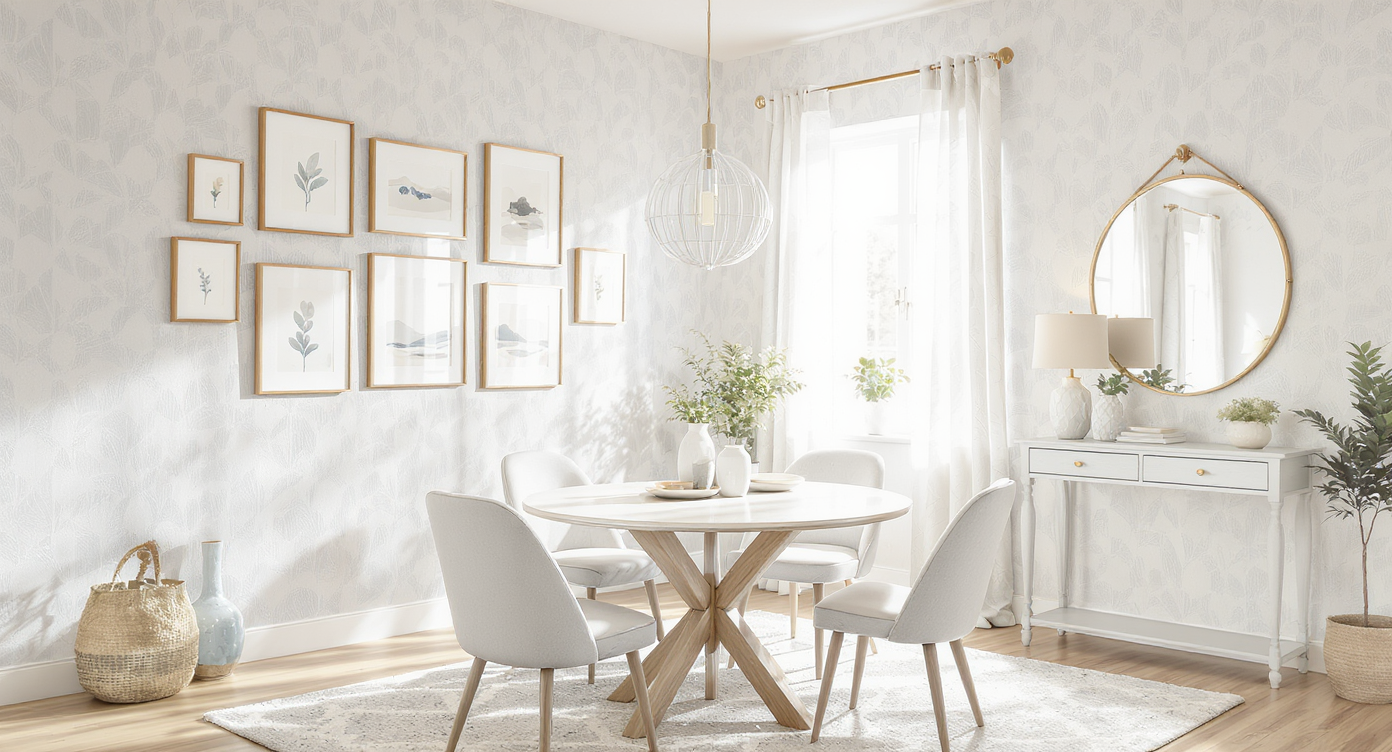
Gallery walls or slim consoles anchor your dining space while keeping circulation paths open.
The fastest way to finish a blank dining room wall is to add one visual anchor: either a single large artwork (about two-thirds the width of your table) or a slim console table with a mirror and lamp. If space allows, rotate the table lengthwise to maintain a 36-inch walkway, hang the chandelier 30–36 inches above the tabletop, and choose a rug that extends 24 inches past the chair legs.
- Anchor choices: large art, gallery wall (3–5 frames), slim console/sideboard, statement mirror, or textured wallpaper/wainscoting.
- Layout: aim for a 36–42 inch circulation path; rotate the table if needed.
- Hanging heights: artwork center at 57–60 inches; mirror 6–8 inches above a console.
- Scale: art 2/3–3/4 the width of your dining table; console depth 12–16 inches in tight rooms.
- Lighting: chandelier 30–36 inches above the table; bulbs at 2700–3000 K for dining.
Explore similar layouts on ReimagineHome.
Dining Room Layout Strategy: How to Plan Walkways, Focal Walls, and Art Placement
Maintain a 36-inch minimum walkway around the table to keep the dining room comfortable and code-friendly.
Start with the layout. For better dining room flow and furniture placement, rotate your table lengthwise if it frees a 36–42 inch path on the most-used side of the room. Align the table with the wall you want to feature so the focal point reads clearly from the doorway.
Option A: large art as the focal point
Size artwork to 2/3–3/4 the width of your table for balanced scale.
- Hang so the artwork’s center is 57–60 inches from the floor (eye level).
- If hanging over a buffet or console, leave 6–8 inches of space above the surface.
- Choose warm, earthy tones to echo dining chairs or wood tones; matte frames reduce glare.
Option B: console table or sideboard
A console depth of 12–16 inches keeps small spaces feeling open; a sideboard is often 16–20 inches deep.
- Ideal height: 30–36 inches, with buffet lamps 24–28 inches tall for soft, low glare lighting.
- Mirror width: 1/2–3/4 the console width; hang with the bottom 6–8 inches above the top.
- Style the surface with a vase (18–24 inches), a bowl, and no more than 3–5 objects for calm balance.
Option C: gallery wall, calm and curated
Keep frame spacing tight at 2–3 inches to read as one composition.
- Use 3–5 medium frames with a consistent finish (black, walnut, or brass).
- Echo the room palette—rusts, creams, muted greens, or black-and-white photography—to integrate with the pendant and chairs.
- Anchor the grouping to the table centerline so the dining room wall ideas feel intentional.
Option D: texture or architecture
Chair-rail height typically lands at 32–36 inches in an 8–9 foot room.
- Paint + wainscoting adds dimension; try a soft cream above and color below to ground the space.
- Peel-and-stick linen or grasscloth wallpaper in beige or sand tones warms white walls without a full remodel.
- For drama, a single accent wall in matte black works if the room gets ample daylight.
When to choose which? Large art suits minimalists; a console or sideboard adds serving/storage; a gallery wall personalizes; wallpaper or wainscoting brings texture. Try this workflow in ReimagineHome.
Anecdote
When I moved into a white-walled townhouse, I lived with a blank dining wall for months. The breakthrough came when I taped out a 48×72 inch rectangle—suddenly, I could “see” the large art the room needed. I found a soft abstract, hung the center at 58 inches, and added two buffet lamps on a slim 14-inch-deep console. The entire room felt done in a single afternoon.
Avoid These 5 Dining Room Design Errors: Scale, Lighting, and Layout Tips
Art that’s too small makes the wall feel bigger and emptier, while proper scale (2/3–3/4 table width) visually completes the room.
- Mistake: Too-small art. Cause: Choosing by budget, not scale. Fix: Combine pieces into a grid or choose one large canvas sized to the table.
- Mistake: Console too deep. Cause: Not measuring walkways. Fix: Cap depth at 12–16 inches to keep 36 inches clear.
- Mistake: Chandelier hung high/low. Cause: Default chain length. Fix: Adjust to 30–36 inches above tabletop; dim to 50–60% for meals.
- Mistake: Gallery wall chaos. Cause: Mixed frame sizes/finishes. Fix: One frame color, 2–3 inch spacing, centerline at 57–60 inches.
- Mistake: Undersized rug. Cause: Buying to the table, not the chairs. Fix: Ensure the rug extends 24 inches beyond all sides; common sizes are 8×10 or 9×12.
Designer-Approved Tips for Perfect Dining Room Lighting and Balance
Warm white bulbs at 2700–3000 K create flattering dining light and reduce glare on glossy frames and mirrors.
- Layer lighting: pair a soft pendant with two buffet lamps on a dimmer for adjustable mood lighting.
- Consider a low-profile picture light (8–12 watts LED) above large art to add a gentle halo without hot spots.
- Color strategy: repeat a hue from the chairs or rug at least twice on the wall (art tones, mat color, or lamp shade) for cohesion.
- Hardware mix: designers often note one matte and one polished metal finish feels curated; limit to two finishes in small dining rooms.
- Door detail: painting an adjacent door satin black can frame the composition and tie into dark frames or a black console.
Anecdotes and real stories
Real rooms often turn on one decision made with a tape measure and 20 minutes.
- A narrow condo dining nook felt cramped until we rotated the table 90 degrees, opening a 38-inch path; one oversized landscape (70% of table width) instantly finished the wall.
- A young family scored a vintage sideboard; a simple round mirror 3/4 its width and two linen-shade lamps turned it into the weeknight drop zone and weekend buffet.
- As renters, a couple used peel-and-stick grasscloth; they hung a 2×3 grid of travel prints with 2-inch spacing, all in walnut frames—personal yet tidy.
- One homeowner tried matte black on the back wall; because the window opposite floods the room with daylight, the space felt dramatic but not heavy.
Visualization Scenario
Picture an 84-inch table centered on a textured wall, with 36 inches of clearance to the right for an easy pass to the kitchen. A 56-inch-wide landscape floats at 58 inches to center, lit by a pendant resting 32 inches above the tabletop; a 60-inch console below holds a stone bowl and a single branch. Visualize your space transformation now on ReimagineHome.ai: https://www.reimaginehome.ai/?utm_source=blog
FAQ
How do I choose between a gallery wall and a console table for my dining room wall?
Pick a gallery wall if you want personal art and minimal furniture; choose a slim console (12–16 inches deep) if you’ll use storage and buffet lamps. Visualize both options in minutes on ReimagineHome.
What size should dining room art be over my table?
Choose art that’s about 2/3–3/4 the width of your dining table so the scale feels balanced and intentional.
How high do I hang a mirror above a console table?
Hang the mirror so the bottom sits 6–8 inches above the console; aim for the mirror to be 1/2–3/4 the console’s width.
What’s the best rug size for a dining room?
The rug should extend 24 inches beyond the table on all sides so chair legs stay on the rug; 8×10 or 9×12 are common fits.
How high should a dining room chandelier hang?
Position the chandelier 30–36 inches above the tabletop and use 2700–3000 K bulbs for warm, flattering light.
Wrap-up
Here’s the bottom line: your back wall only needs one clear move—large art, a console and mirror, or a tight gallery—with the table aligned and lighting properly scaled. Measure first, keep that 36-inch walkway sacred, and echo your room’s warm tones so everything feels intentional. Once you place the anchor, the rest (rug, chandelier swap, a few objects) becomes pleasantly obvious.